
Since Warhammer: The Old World came out, a lot of players have been trying to make 400–750 point games feel “real” without turning them into a completely different ruleset.
Games Workshop’s answer is Warhammer Battle March—a smaller, faster format introduced in the Arcane Journal: War of Settra’s Fury AND in 2026 was updated with the Arcane Journal: Battle March: General Companion. It’s designed for skirmish-sized games, and it can also be used to run an allied contingent inside larger armies.
If you want the rules at a glance, here’s the quick summary first—then we’ll break down the limitations, scoring, and missions.
Alright—here’s how it works (Updated post to the last Battle March content).
Jump to:
Quick summary · Limitations · Victory Points · Missions & objectives · Maps & deployments ·
Cheapest way to go Battle March
What’s Warhammer Battle March about?
–Recommended setup: smaller board, capped terrain size, and fixed objective layouts + a few deployment types.
–Turns: 5 (instead of 6).
–Points: 400–750 (and usable as an allied contingent in 2000–3000).
–Army restrictions: lighter minimums, but tighter caps on characters and unit categories.
–Scoring changes: General/standards/objectives adjusted; objective control is 3″ with Unit Strength 5.
Limitations of Old World Battle March
The minimum number of non-character units you must include is 2 instead of 3 (which is the limitation in standard armies). These 2 units can be war machines, but swarms and war beasts don’t count.
Of all the units and options in the army that are 0–1 per 1000 points, you may include only one choice (you couldn’t take a Goblin Spear Chukka and also give “Skirmishers” to an Orc regiment, because both are 0–1 and you’d have to pick just one).
- You must include a character to be your General.
- No character may cost more than 25% of the total points.
- No Core unit may cost more than 35% of the total points.
- No Special unit may cost more than 30% of the total points.
- No Rare or Mercenary unit may cost more than 25% of the total points.
- Updated because of the new book: no unit can have Unit Strength higher than 20.
Victory Points in the new Warhammer Battle March
Use the same Secondary Objectives and Victory Points as the Matched Play Guide (July 2025), with these changes:
- Killing the General is 50 instead of 100.
- Each enemy standard is 25 instead of 50.
- Battle Standard Bearer is 50 instead of 25.
- Each Treasure you control on your player turn: 10 VP / 25 VP for the Landmark.
- Objectives are controlled at 3″ instead of 6″, and with Unit Strength 5 instead of Unit Strength 10 (not fleeing units or units that have failed stupidity).
- If 2+ units can control it, the closest unit does. If they are at the same distance, the one with highest Unit Strength and if they have the same Unit Strength, neither unit controls it.
Do these feel like only a few changes? That’s because… it is. But hold on—check out the new missions:
Battlefield Layout and Objective Markers in Battle March
Although it says you can play any scenario from the normal game, they recommend playing with the following variations and objective layouts:
- On 30″×44″ boards if you are playing <600 points, and 36×48 if the armies are 600+ points (this has been updated with the new book).
- With no terrain piece measuring more than 12″ at its widest point.
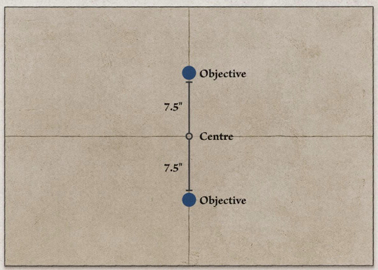
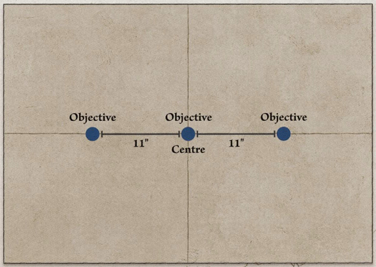
- UPDATED: Once terrain is placed, roll a dice. On a 1–2 you place 2 Treasure Troves; on a 3-4 you place 3 Treasure Troves and 5-6 means one strategic landmark (I’ve put the layouts below in images, because the objectives have fixed positions).
- Treasure Troves use 40mm bases (like Stormcast Eternals or Terminators).
- New Strategic Landmark uses 100mm round base and is impassable terrain, and blocks line of sight. Always placed in the center of the battleground.
- Those objectives are placed according to these two diagrams, with the exception that no objective can be within 3″ of a terrain feature. If that happens, you must move the ELEMENT (not the objective) the minimum distance so that it no longer is.
Remember that each objective gives 10 victory points in each player turn to whoever controls it, while the Strategic Landmark gives 25.
Advantages of Controlling the Strategic Landmark
Each Treasure gives 10 Victory Points at the end of each player turn to whoever controls it, while the Strategic Landmark gives 25 points per turn.
But ON TOP OF THAT, the new book tells us that the unit controlling the Landmark at the end of either player’s turn gains a benefit until the end of the following turn.
How is that benefit determined?
At the start of the battle, either player rolls a die. That result determines the benefit the Landmark provides for the entire battle. It does not change, and you do not roll again each turn.
1-2: Magic Resistance 2.
3-4: Frenzy.
5-6: Stubborn.
Before this game mode was updated, there were two objective setups combined with 3 deployment types, giving us 6 different battle setups. Now there are 3 objective setups and 6 deployment options, DOUBLE the number, giving us 18 different types of battle.
What are those deployments? Here they are.
New maps and deployments in Warhammer Battle March
Once the objectives are placed, roll a D6 to determine deployment type:
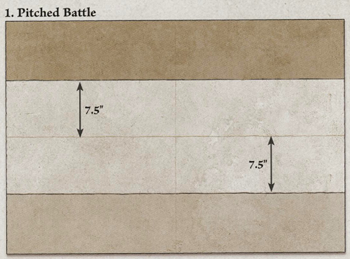
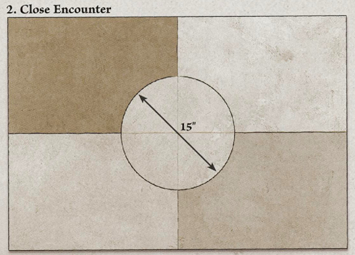
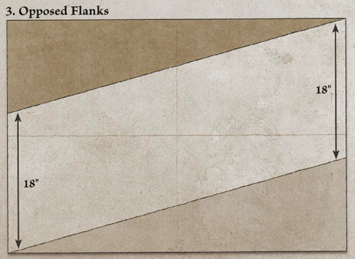
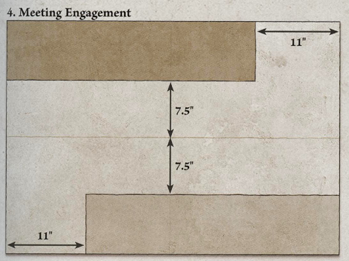
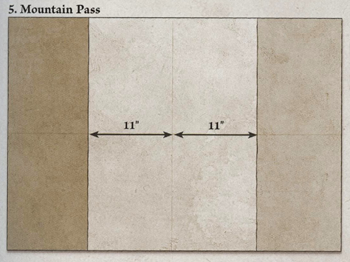
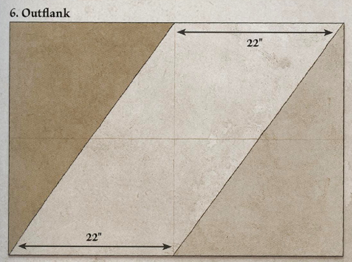
In maps 2 3 4 and 6, if both players agree, the allowed deployment band can be mirrored from right to left or left to right.
Note: GW says the player who didn’t roll the dice chooses the deployment zone.
As if rolling the die gave any kind of advantage.
Anyway.
Here’s a change compared to normal games: The player who chooses the zone does not start deploying; instead, both players roll a die and the winner starts deploying.
He cannot choose. The player who rolls higher simply deploys first (alternating units—this part works as usual).
When all units have been deployed, both roll another die and the winner chooses who takes the first turn. There’s no +1 for the player who finishes deploying first.
With this, you guys have everything you need to play skirmish games using the Battle March rules.
The thing is, in the new 2026 Arcane Journal, apparently the expansion still wasn’t enough for them, so they added a bunch of OPTIONAL rule packs which, being optional, you can perfectly well play without. I’m going to explain all of them, but in a separate post that I’ll link right at the bottom.
The point of this post is to help people get started with Old World, not make things more complicated with rules that are sometimes used, sometimes not, and where you have to keep deciding which packs you’re playing and which ones you aren’t. That makes no sense to me.
What I do think makes sense for getting into the game is giving you a list of which miniature boxes to buy so you can get started while spending as little money as possible. That’s what the next section is about.
By the way, what miniatures should I buy to start playing Warhammer The Old World?
I’ve noticed that posts about which boxes are worth it and which ones aren’t, how to start collecting an army while saving money, etc., are really helpful for you. So I’m planning to make a dedicated post about that for each army.
The problem is that it’s going to take a while, because I just don’t have the time. It’s quite a lot of work (and so are the list breakdown posts, and the magic analysis ones…).
So here’s a quick summary:
In my opinion, the army boxes, battleforces or spearheads that are actually worth it when starting an army are:
Cathay: probably the luckiest faction. There are two battalions and both are solid, although I personally prefer this one, the newer one. The other option is this one, which leans more towards elite units.
UPDATE: Ok it’s even better. They have now this new box, which is a mix of the previous ones (it’s supposed to be specifically made to battle march.
BUUUUUUT if you are lucky enough (usually, they have limited boxes) and you are interested in Cathay AND Chaos Warriors (or you have someone to share) The New Core Set is, by far, the best option to me.
Wood Elves: their battalion is very good.
High Elves: The Old World battalion is terrible, the Lumineth spearheads are also bad, and the Lumineth battalion is bad as well (just slightly less so). Sorry, there’s no real hope here. I’d try to get a solid cavalry bundle with Ellyrian Reavers, Silver Helms and archers.
Empire and Renegade Crowns: the battalion is very solid. Even if it’s out of stock on Wayland, if you can find it elsewhere it’s definitely worth it (for Renegades you won’t use the tank, but the infantry alone makes it worth it).
Dwarfs: I like the battalion.
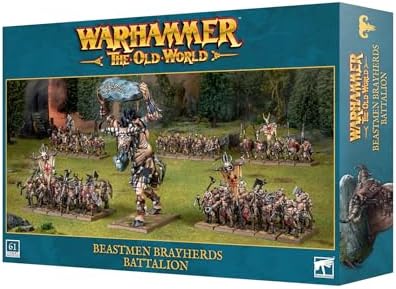
Beastmen: the battalion is excellent. In fact, the monster it includes can easily be used as a Giant Spawn of Nurgle (which is very strong in-game, and the original model is awful).
Bretonnia and Tomb Kings of Khemri: Even though they come with the rulebook (and I generally don’t recommend buying rulebooks for this game), I think both battalions are very solid. This is the Bretonnia one and this is the Tomb Kings one.
I really don’t like the battalion. It lacks too many “cheap” units. I’d wait for the new Spearhead magazine releases, which should include Chaos Warriors and Knights at a better price.
Orcs & Goblins: probably, along with High Elves, the worst battalion in the game. Keep in mind that Night Goblins are the most played option, so I’d look for a Gloomspite Gitz starter box from Age of Sigmar and use the trolls as fillers for your Night Goblin units.
Warriors of Chaos: UPDATE HERE: The New Core Set is, by far, the best option to me (problem might be that you will have to buy Cathay too, or find someone to share with). I’m not sure how long that box is going to be available. I hope you can get your hands on one if you’re interested, because the miniatures are amazing.
That said… below you’ll find the posts I mentioned in the article.


Related Posts:
Warhammer Battle March: All the New OPTIONAL Content
Warhammer The Old World: The ultimate guide to Get Started in 2026
✠ Warriors of Chaos in Warhammer: The Old World: Guides, Rules & Army Lists
Chaos Dwarf Tier List for Warhammer The Old World (2026–2027)
Chaos Dwarf Old World List: WTC 2026 World Championship Winner
Hordes of Chaos | New Army of Infamy | The March of Chaos Arcane Journal
Any errors in the post? feel free to reach out at theoldwarrior@theoldwarrior.com.