In this breakdown we dissect a list from the latest The Old World world championship with two Star Dragons, lots of armour and key support pieces, so you understand how it’s played, how to get the most out of it… and how to deal with it if someone puts it down across the table from you.
Today we’re going to look at Matthew’s list, from Switzerland, a High Elves player.
First of all, congratulations to him for his great results as a High Elves player on his team. This is a team event list, like many others I’ve already covered, with different variations so you can play it and adapt it to your own playstyle.
Let’s dive in.
General context and constraints the list was built for
Event format and structure
This list was created for an eight-player team event where pairings are arranged beforehand (it’s possible to “protect” certain lists. For example, if a teammate brings no magic defense, it’s very possible to “shield” them so they never face a magic-heavy list in any round, which affects list composition and makes them differ from a singles event where you can’t “dodge” a pairing no matter how rough it looks).
General army restrictions
- Maximum 500 points in a single character or unit.
- Allied are not allowed, but Mercenaries are.
- Your army may only include 0–2 Level 3 Wizards and/or 0–1 Level 4 Wizard.
Category limits
0–3 Characters: Character subtypes listed under the same unit entry (e.g., Chosen Lord, Exalted Champion, Aspiring Champion) are considered part of the same unit entry for this rule.
0–4 Core
0–3 Special
0–2 Rare and Mercenaries
If the same unit entry appears in multiple categories (e.g., Special and Rare), all of them count toward the most restrictive applicable limit. Example: Cathay can only take 2 giants at most, no matter how many Shugengan they include to field them as Special instead of Rare.
Character mounts count as part of the corresponding unit entry if that mount exists as a standalone unit (e.g., Heavy Chariots).
Named characters are exempt from all restrictions.
Secondary objectives and victory conditions
All games last 6 turns—no Break Point or variable game length (if you don’t know what I mean, here are the victory conditions from the Matched Play Guide explained).
Secondary objectives: The list is designed to play a total of 4 combined secondaries in each game (Domination or quadrants count as 2).
For example, one round might be baggage trains (1) + 2 strategic locations (1+1) + special feature (1), while another might be domination (2) + 2 strategic locations (1+1). In both cases there are 4 total objectives combined in different ways.
This is crucial, because lists are tweaked around the pack and would be different if you played all secondaries at once each game, or only 1 secondary per game.
Line of sight special rules
Large targets are only blocked by other Large targets. Neither hills nor impassable terrain block (at the event this list was built for) large targets.
High Elves 2000 points Army list Warhammer The Old World
495 – Archmage, Pure of Heart, Star Dragon, Wizard Level 3, Illusion, Seed of Rebirth, Talisman Of Protection
497 – Prince, Light Armour, Shield, Pure of Heart, General, Star Dragon, Sword of Might, Armour of Caledor, Seed of Rebirth
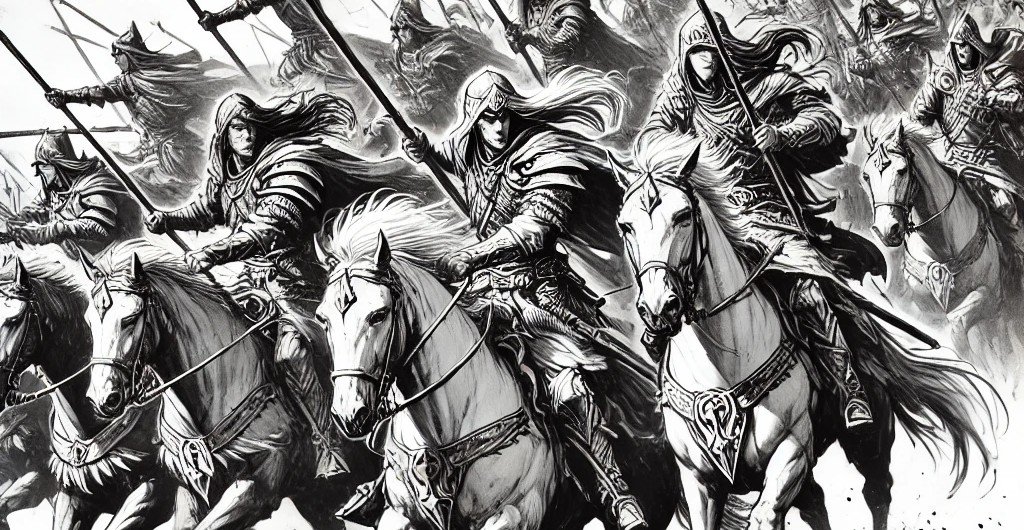
88 – 5 Ellyrian Reavers, Cavalry Spear, Harbinger
88 – 5 Ellyrian Reavers, Cavalry Spear, Harbinger
198 – 8 Silver Helms, Shield, High Helm
126 – 5 Silver Helms, Shield, High Helm
192 – 5 Dragon Princes, Drakemaster
192 – 5 Dragon Princes, Drakemaster
60 – Great Eagles
60 – Great Eagles
How to play High Elves in The Old World and how to play against High Elves
This list has two dragons that hit very hard, and units whose job is to support them and allow them to do the damage they’re supposed to do, while also being very mobile themselves.
For this type of list, combined charges are crucial, because any dragon that charges a unit with a champion on its own won’t do much more than kill the champion and will probably lose the combat. So in this list, you absolutely must support your dragons.
Ways to support your dragons in High Elves lists in The Old World
One option is to charge the same unit with both dragons, and another is to charge in with one of the cavalry units plus a dragon. For that you need all these cavalry units to have a unit champion so they can issue the challenge and let the dragon hit the rank and file, even if it’s charging alongside light cavalry.
Bear in mind that even if the light cavalry isn’t very tough, the dragon should usually clear the front ranks and therefore prevent the light cavalry from suffering too much.
On top of that, remember that both heavy and light cavalry have a very good Movement value. That means you can use them in a very flexible role: hunting enemy supply trains, sitting on objectives, grabbing table quarters and even protecting your own supply trains.
But that’s not all: in this edition, as we know, you can flee as a charge reaction and then march in the same turn. So the classic redirector role, which in previous editions was limited almost exclusively to light cavalry, can now be done by any unit with good Movement and Swiftstride, and this list has several of those.
Keep in mind that Dragon Princes of Caledor are impetuous and don’t have Frenzy, so in a pinch they could flee as a charge reaction, although with counter-charge available you won’t see them do this very often.
When it comes to movement, all these cavalry units can triple their Movement by going into marching column, so they move 24″, which is pretty insane.
On top of that, Dragon Princes can even charge thanks to the Drilled rule, even if they started the turn in marching column, so as the opposing player you have to be very careful around a unit like that. (There are others in the game that can do this too, like the Huscarls of the Chaos Sea Wolves, for example.)
The role of war eagles in High Elves in Warhammer: The Old World
It might look to some players like war eagles aren’t very good, but the truth is that for 60 points they bring some very important tools. Anyone can see they’re a good redirector, a unit you can use to flee as a charge reaction and sacrifice if needed, and they’re also great at hunting down war machines and lone wizards.
But beyond that, we need to understand how Leadership checks and losing combats work in this edition. When a unit passes a Leadership check after losing a combat, it will fall back out of combat unless it has a friendly unit directly behind it and bumps into that unit, because it’s in base contact and literally can’t fall back.
So when the dragon loses a combat, or a cavalry unit loses a combat, if it has a giant eagle directly behind it in base contact, it will not fall back and they’ll all keep fighting in the enemy’s turn, not just in the turn they charged. That can be very interesting.
On the other hand, when the unit fails its check, whether it flees normally or in good order, if one of our units has a friendly unit directly behind it – like a giant eagle in this case – it will move through the eagle and can never be caught by the enemy, because the pursuers will hit the giant eagle instead.
So this eagle gives you a lot of safety.
Cavalry can technically do this “unit behind to block” trick as well, but keep in mind that if your front unit stays locked in combat, your cavalry behind it will very often be blocked for your following turn, since it can’t fly. That’s why the giant eagle is the perfect tool for this role: you angle it slightly so it still has some line of sight towards one of the dragon’s flanks.
The High Elf Prince on Star Dragon in The Old World
The Prince is packing Armour of Caledor and a shield, so he saves on 3+, and with the Sword of Power he has magical attacks in case he runs into anything ethereal, hitting at Strength 5 with AP -1 and adding a bit of punch while keeping the “Always Strikes First” rule he’d lose if he took a great weapon.
Honestly, he’s not the character that does the real damage, because, as we all know, the dragon is the one that does the heavy lifting. But he does help to keep the dragon alive, because with Blood of Caledor he has a 6+ ward save, and combined with his 3+ armour and Seed of Rebirth, which for 20 points gives him a 5+ regeneration save, he becomes very resilient.
Archmage on Star Dragon in a High Elves list
Again, with this build the priority is protecting the dragon, so this player has given the Archmage a Talisman of Protection and another Seed of Rebirth, giving him a 5+ regeneration save. That means a 4+ armour save and then 5+ ward and 5+ regen.
He’s a Level 3 wizard and has chosen Illusion, the Illusion lore in The Old World.
What might he be looking for by picking Illusion over Battle Magic, Elementalism or High Magic?
To start with, the Illusion signature spell is excellent on a model like the Star Dragon, because it gives it -1 to be hit, with a casting value of 8+. So, as a Level 3 – rolling one power die plus his level – it’s very easy to get off.
The problem with Illusion is that, although it has a few low-value spells, several of them are pretty bad on this particular character, like spell 1, Mindrazor; spell 2, Shimmering Dragon; and spell 5, Spectral Doppelganger.
I’m guessing the player is praying hard not to roll several of those and instead to roll something like Crystal Column or Miasmic Mirage, spells 3 and 6 from Illusion, because they’re great at disrupting enemy movement. And even though they have a fairly high casting value (10+), thanks to Blessing of Lileath he can reroll one of them each turn, which is a very nice bonus.
things that are basically locked in for any High Elves cavalry list
- Right now the High Elves meta is very much about double dragon. So even though I personally find the idea of double wizard on dragon very interesting, at the last Worlds every player was running one wizard on dragon and one prince on dragon.
- The double dragon is always two Star Dragons. You’re not going to see Sun Dragons or Moon Dragons in these lists. They’ll always have Seed of Rebirth for a 5+ regen, plus some kind of additional ward save, either from Talisman of Protection or from Blood of Caledor.
- Most of the Core points in this fast cavalry double-dragon list are covered by two units of Silver Helms.
- The dragons are always supported, though what supports you choose will vary by taste. On their own the dragons do not work. They’re much easier to counter if they don’t come with the right support units, which is what we’ll go over in the next section on differences.
The worst High Elves units you’ll never see in competitive lists
You’re not going to see Eagle Claw Bolt Throwers, because High Elves nowadays simply have much better options. When the game first dropped they weren’t that bad compared to the other shooting options the army had, but infantry has been improved a lot since then, and so have basic scoring units that didn’t use to score.
Ellyrian Reavers are better, Sisters of Avelorn are better, and all of this means there’s really no good reason to include Eagle Claw Bolt Throwers.
On top of that, besides the 50-point bow that works like a bolt thrower and can go on the unit champion of the Sisters, since November, when the Razing of the Westerland Arcane Journal was released, there’s now another bow that’s quite interesting: Strength 5, Multiple Wounds (2), and it can also be taken by a Sisters of Avelorn unit champion.
You’re also not going to see cheap support characters like mages or nobles on foot or mounted, because all your character points are going into the two Star Dragons, which is the strongest option in a list that, as we’ve seen, is basically built around those dragons and their support.
You also won’t see a Level 4 wizard on Star Dragon, because you can’t fit that into 500 points unless your event explicitly allows more than 500 per character – and I haven’t yet seen an event that ignores that cap, it’s almost always enforced.
In terms of Core units, you’re basically never going to see defensive infantry units like Spearmen or Lothern Sea Guard, because they’re slow and get left behind by the rest of the list, and they’re also expensive. The role they’d play is already covered by your cavalry (I like them and they’ve improved a lot with 1.5, but in a double-dragon meta they just don’t really fit).
You also won’t see Sisters of Avelorn as a Core choice anymore, because no one is going to take the Everqueen’s Handmaiden, just like no one is taking any of the other minor characters we already talked about.
On top of that, elite infantry or Shadow Warriors aren’t really being played either, for the reasons I already explained in the High Elves unit tier list post – if you want to read that, I’ll link it down below.
Chariots aren’t showing up either, neither White Lion Chariots nor Tiranoc Chariots, because even though they’re fast, they’re quite fragile and don’t hit that hard for their cost. And of course they have the classic chariot problem: they don’t get Impact Hits if the enemy is too close. So your opponent can move within 3″ and basically turn your chariot off, very cheaply and very easily.
You also won’t be seeing the Flamespyre Phoenix. That thing is such a disappointment I’m not even going to waste time on it.
Possible variations in competitive High Elves lists
There are players who prefer double prince instead of the mage-and-prince setup.
You can even run double wizard on dragon, even though we didn’t see that in any of the Worlds lists.
The magic items are also flexible; you don’t have to use this exact loadout. Some people won’t give the prince this exact sword and will instead take a Flaming Sword for 5 points so he has magical attacks, or even give him a cavalry lance or a great weapon, which are perfectly reliable options because the prince always strikes first, so he hits in initiative order at a very high Initiative value and with Strength 6.
As long as he has some sort of ward save, you’re fine. You don’t always need to spend 30 points on a Talisman of Protection, because you already have access to Armour of Caledor plus Blood of Caledor for that 6+ ward, which means you can drop some of the magic-item investment and still stay well protected.
The one-use talisman that gives you a 2+ ward save is also an excellent choice for 20 points. You usually save it for the first cannonball or stone thrower hit of the game, a big Multiple Wounds hit.
On the magic lore side, besides Illusion you can also get good mileage out of High Magic, which, even though the spells are generally harder to cast, has some very interesting tools like Walk Between Worlds, which turns your dragon ethereal and therefore immune to cannonballs, stone throwers and all the other things that can really ruin its day.
In that light, Battle Magic might not be that attractive for this specific build.
Another possible tweak: Ellyrian Reavers
Giving Ellyrian Reavers the skirmisher rule is still an option, although of course it makes them more expensive. And if your plan is to play them in marching column a lot of the time just to triple their movement, then it’s not really worth it; short bows are also too expensive.
In that context, the cavalry lance makes more sense.
Another option is to configure your units of Silver Helms and Dragon Princes for a slightly different role. If you need them to be a bit tougher, or to act more like a dedicated hammer instead of pure support, you can simply add more bodies or maybe give them a standard. Some players will also increase their hitting power by giving the unit champion the Ring of Fury for 25 points, allowing them to cast Hammerhand at Power Level 1.
Since Hammerhand has a casting value of 7+, you only need a 6+ on the die, which is fairly easy. It’s not bad at all; it just comes down to thinking about what exact role you want the unit to fill.
Otra de las opciones es cambiar el águila por Escolta Celeste. Tiene algunas funciones parecidas, pero EscolSwapping the eagle for a Celestial Escort
Another option is to swap the eagle out for a Celestial Escort. It has some similar roles, but the Escort hits harder. And, as I’ve explained in previous High Elves breakdowns, I still wouldn’t pay for the bolt thrower upgrade on it.
Even though this particular list doesn’t run Sisters of Avelorn, they’re always a solid unit and absolutely something you could include in a list like this thanks to their huge range, even if they’re not very fast. You can even play them with the Ambushers rule as a dedicated tool for sniping the enemy supply train; even if you only pay for that rule for that specific mission, at 1 point per model if you’re taking around seven Sisters, that’s not bad at all.
In most games, though, you’ll want to deploy them normally in your own deployment zone so they can start shooting from turn 1.
A good idea is to give the unit champion either the Bow of the Seafarer or the Ruby Ring of Ruin, because that complements the unit really well, adding long-range damage at exactly the distance you want to keep your Sisters of Avelorn from danger.
I’ve also seen people put Loremaster’s Cloak on the unit champion, since it gives the whole unit a 4+ ward save against any kind of magical projectile for 25 points. Because the Sisters of Avelorn are skirmishers and usually at long range, they don’t tend to get shot by normal missiles very often, but they can be prime targets for magical missiles and you do need to protect them.
If you feel that just keeping them far enough away is enough protection, you can skip the cloak and save those 25 points.
The Frostheart Phoenix as a last option
Finally, the last remaining option is the Frostheart Phoenix, which can also be interesting as a partner for one of your dragons. The problem is that it can’t accept challenges. That means the model in base contact with the enemy champion is the Phoenix, while the dragon gets stuck fighting the enemy unit champion.
The Phoenix only has four attacks and two Stomps, so the damage it does might not be enough, and you’re usually better off supporting the dragon’s charge with a unit that has a champion, like this player has chosen to do – and like many of us prefer to do – to maximise the damage output.
In short, the High Elves double-dragon cavalry list works because the entire army exists to let the two Star Dragons do their job and not die for free. If you understand what support they need and what small tweaks you can make without breaking the game plan, you’ll stop giving away games and the army will finally start to click.
If you want to keep fine-tuning your High Elves lists, I highly recommend checking out the unit tier list and the other Worlds lists I’ve covered after you finish this breakdown; they’ll give you tons of ideas to adapt this core to your own meta and playstyle.
Related posts to help you play like a god HERE:
Competitive Army lists for Warhammer The Old World – 2000 points
High Elves units TIERLIST Warhammer The Old World
🔹WARHAMMER THE OLD WORLD HIGH ELVES
Is the Beastmen Primal Magic lore good? In-depth analysis – Warhammer The Old World
Scouts in The Old World | Best deployment ever?