

'/%3E%3Cpath%20fill='%23b2b2b2'%20d='M241%20382q0%2016%2017%2026%2017%2011%2042%2011t42-11q16-11%2017-26V269H241'/%3E%3Cpath%20fill='%239f7e00'%20d='M241%20379q0%2014%208%2023%209%209%2021%209%2014%200%2021-9%209-9%209-23V269h-59'/%3E%3Cpath%20d='M241%20339v-70h59v110q0%2014-9%2023l-6%205v-68h-15v72q-8%200-14-4v-68zm59%2040c0%2022%2015%2032%2029%2032%2021%200%2030-18%2030-32v-40h-59'/%3E%3Cpath%20fill='%239f7e00'%20d='M266%20277v5h2v12h-3v-5h2v-5h-9v5h2v5h-4v9h3v18h-5v10h34v-10h-5v-18h3v-9h-4v-5h2v-5h-9v5h2v5h-3v-12h2v-5zm42%20101q0%2010%206%2017%206%206%2015%207%2010-1%2016-7%206-7%206-17v-29h-43'/%3E%3Ccircle%20fill='%230044ad'%20cx='329.5'%20cy='372'%20r='6'/%3E%3Cellipse%20fill='%230044ad'%20cx='300'%20cy='340'%20rx='16'%20ry='21'/%3E%3C/svg%3E)
These posts where I analyze all the magical options an army has are hard to make.
They take time, a lot of time.
I record them while I’m walking down the street, but then they need reviewing, and even though AI helps with transcription… sometimes it doesn’t help much.
Today we’re doing High Elves. I’ve already analyzed the magic of Warriors of Chaos and Beastmen.
I was going to start with Dwarfs, but I finished quickly.
Anyway, if these posts help you, what helps me is you sharing my content with people who are into Old World.
Thanks a lot, let’s get into it.
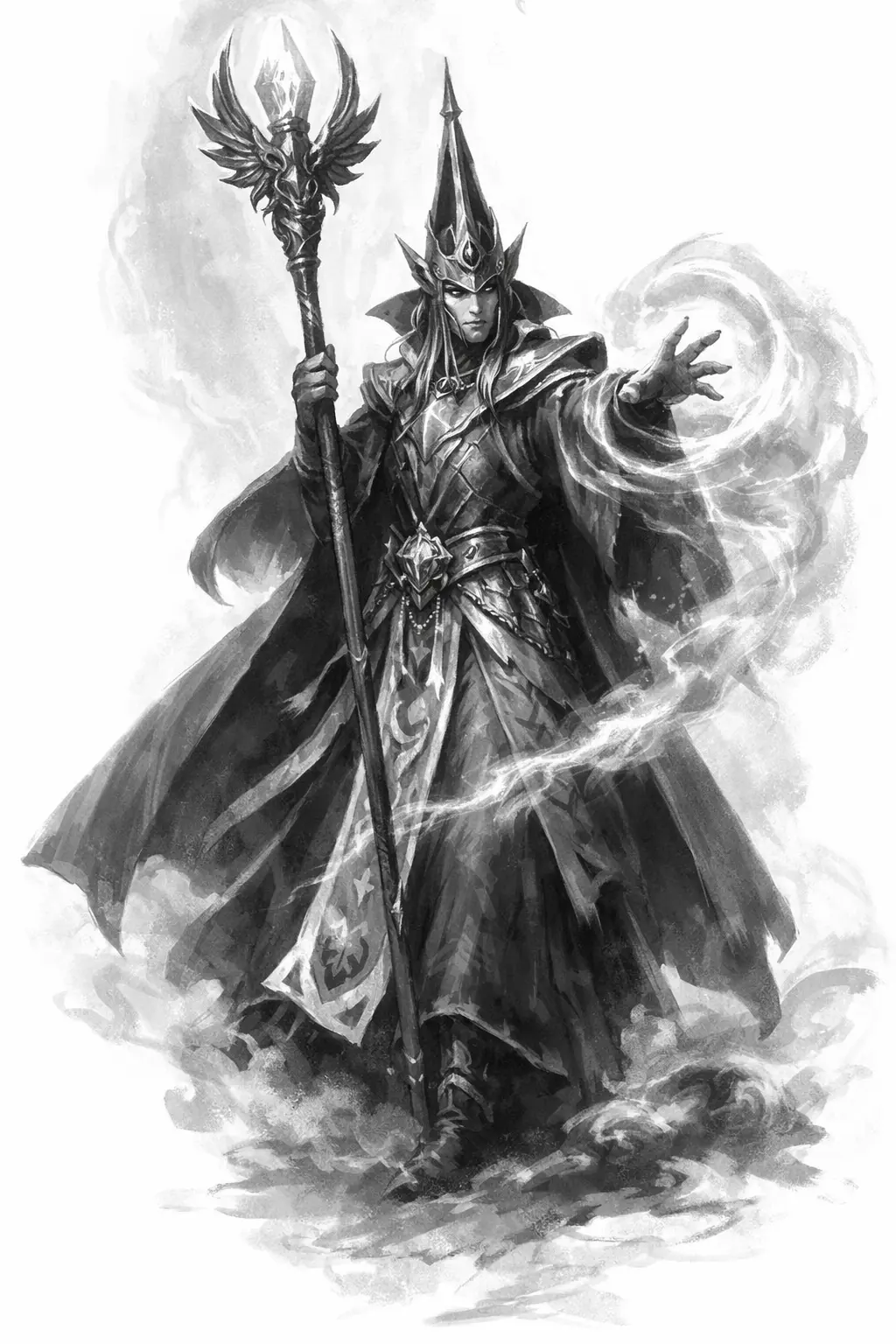
The magic of the High Elves, another army similar to Chaos, where the meta is based around double dragon when it comes to characters, so a lot of the time we don’t have the option to use wizards.
However, unlike Chaos, with High Elves there actually is the possibility of swapping a Prince on a Dragon for a wizard on a Dragon if we want to play meta… well, keep playing meta. And on the other hand, there are a lot of players who don’t want to use double dragon and do consider more character options. In this post we’re going to cover all the magic options this army has, the combinations and synergies that exist with racial abilities, units and bound spell items, and also racial signature spells.
Lileath’s Blessing in Warhammer The Old World
Let’s talk about the High Elves’ racial rule. All High Elf wizards, whether level 1, level 2, 3, 4, except for the Stormweaver, have the racial ability to re-roll the casting of one spell per turn. This allows us, if a spell doesn’t go through, to try to cast it again. So it can be used on the first spell that fails in that turn, re-rolling it, which would be the most common use; but we can also save it for the most important, most powerful spell we want to cast.
In this case, this racial rule makes us think about something, and that is that sometimes we save a powerful spell for last, but with High Elves, in most cases the best idea is probably to cast it first so you can re-roll it if it fails; and if it does get through, then save the racial rule to re-roll another, less relevant one.
Update (thanks Jakub and Jean-Baptiste!): There’s another important detail about this racial rule. In previous editions it was explicitly stated that miscasts couldn’t be re-rolled. In The Old World, this isn’t specified in the Arcane Journal, the Forces of Fantasy book, or the High Elf FAQs. HOWEVER, the main rulebook FAQs do state that if you roll double 1 when casting a spell, it cannot be re-rolled. Watch out for this — I completely missed it at first.
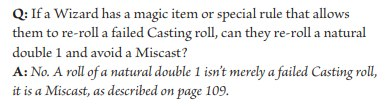
I really don’t recommend that at all because miscasts happen 1 out of every 36 times, and on top of that the damage they do is very situational. Some of them do real damage when the character is inside a unit; others only really matter when he still has a lot of spells left to cast, because they shut down the magic phase early… Anyway, all of this means that what I recommend is casting the important spell first in case the magic phase gets cut short by a miscast later on.
Also, the fact that in this edition you can try to dispel as many spells as you want, as long as your wizard is in range, makes the old sixth edition strategy of saving your big spell for the end when the enemy had no dispel dice left completely useless, because they’re always going to try to dispel it, whether you cast it first or last.
And if the enemy wizard is not within dispel range, it’s very hard for them to dispel anything because you have a +2 with a re-roll and the enemy is dispelling without any kind of bonus using fated dispel.
Racial spells of the High Elves in Warhammer The Old World: the Lore of Saphery
Now let’s talk about the High Elves’ racial signature spells. They have 3:
Hand of Khaine
It’s a combat spell and it does a single Strength 4 hit with no armour save allowed. Even though it has a casting value of 7, it’s complete trash, it’s useless, and I would never turn down having another spell just to take this one. A Hammerhand is much better. Anyway, basically everything is better.
Courage of Aenarion
Courage of Aenarion, casting value 10, range 15. Remains in play enchantment. It makes the target unit unbreakable. Even though it’s remains in play, which we know means the enemy can dispel it again at the start of their own turn, it has a casting value of 10, so it’s very interesting. With a high casting value, it’s harder for them to dispel.
It’s really good for combining with a powerful, durable unit like a Dragon. In fact, this spell is very interesting for a wizard on a Dragon to cast on himself, because the problem we can have is that, as an enchantment, the target unit has to be within our line of sight, and sometimes that’s what ruins the plan. So if the wizard casts it on himself, that can never happen because he is always within his own line of sight.
Also very useful for pulling off the anvil-hammer strategy knowing that the anvil is never going to flee and you’ll be able to make the follow-up counter-charge. But in general, in other cases it’s not that interesting with typical elven units because they’re not very durable.
Vaul’s Unmaking
Honestly, this spell made more sense before, when the game first came out and a level 4 wizard cast with +4, than it does now in the meta, because there were also certain magic items that got used more than they do now, like the Bretonnian Horn, like the Ogre Blade on the Chaos Lord on Dragon and other hard-hitting characters that, because of the changes and limitations the game has gone through, don’t really show up as much anymore.
Anyway, I don’t like the spell; it has a very high casting value, 11, and only 12″ range, while being a Hex that can’t be cast in combat, even though it can be cast on an enemy character who is engaged in combat.
What it does is destroy one of their magic items, chosen by the elf player.
You’re not going to be able to cast it many times, probably once per game if I had to guess, and it still has to cast successfully, 11+. So with all the other spell options we’ll be looking at now, it never makes sense to me to choose this spell.
Long story short: out of the three racial signature spells we have as High Elves, the only one I like is Courage of Aenarion.
Let’s see what we can combine it with, because High Elves have access to Elementalism, Illusion, High Magic, Battle Magic and Dark Magic if you’re a Stormweaver.
Battle Magic with High Elves in Warhammer The Old World
While Battle Magic has the advantage of low casting values, it has some spells that are absolute garbage, and others that are very useful for every army. However, TODAY we’re only thinking about High Elves, and that means some of those spells that are “generally garbage” also become useful.
The spell that is and always will be, forever and ever, absolute dogshit is number 6, the Panic test one; it forces an enemy unit to take a Panic test.
Hammerhand
For example, Hammerhand the signature spell is for a wizard who’s going into combat. This wizard can spend his time buffing units, casting the hex, and supporting his unit in combat. Hammerhand is a combat spell that does 2D3 Strength 4 hits, an assailment spell. And the important thing is that with High Elves it’s a spell we can spam. Why? Because we have the Ring of Fury for 25 points, a magic item that has this spell as a level 1 bound spell. Since it’s so cheap it can even be taken on unit champions, and it’s common. So, would it really be worth having a wizard with Battle Magic for this spell? Probably not for that exact reason, I’d rather have a Courage of Aenarion, but extra Strength 4 hits are never a bad thing.
Fireball
This lore has the Fireball spell, which is the longest-range magic missile in the game, 24″, and does 2D6 Strength 4 hits. The problem is the lack of armour penetration, but it’s very useful for clearing chaff.
Pillar of Fire
Casting value 9 and range 12, it’s the lore’s vortex. Even though it’s only Strength 3, it does D3+3 hits, which makes it pretty reliable, and it has AP -2. Because of this spell, I prefer the wizard on horseback rather than on foot if we want to focus him on direct damage.
Curse of Arrow Attraction
The lore’s hex, re-roll 1s to hit when shooting against the target unit. It’s very useful when we have an army with Archers, with Sisters of Avelorn, supporting from long range. Compared to other lores, Battle Magic is the one with the longest ranges.
Shield of Oak
5+ ward save for the unit the wizard is in, and at casting value 7 it’s a gift. The problem is that it has to be for an important or juicy unit for the enemy, because otherwise they just won’t shoot it and this spell will be pretty irrelevant.
The setup this lore enables is a cheap support wizard who’s quite flexible. I wouldn’t do it to look for any specific spell combination because I don’t think you need to, not without Lore Familiar, but in a balanced list with varied troops. A cheap wizard where we don’t spend much on magic items can make sense so the player adapts depending on which spells he gets instead of fishing for any specific one.
While there are other lores where the range is so short that taking the wizard on foot makes absolutely no sense because he’ll never get to the target, let alone the target you actually want, this lore does make it viable to take the wizard on foot because most of the spells can still be used effectively whether he’s a character on a monster, a character inside an infantry unit, or a character inside a cavalry unit.
I’ve seen a lot of people using Battle Magic on the wizard mounted on a Star Dragon, and that does make some sense, because that wizard is often combined with units of Sisters of Avelorn, who get a lot out of Curse of Arrow Attraction. Hammerhand is also very useful for these kinds of wizards. Shield of Oak, depending on the combination of magic items, can be too, because a lot of the time to keep this wizard under the 500-point character limit he ends up with no ward save at all, or only a 6+ ward from the Blood of Caledor.
Arcane Urgency, VERY careful!
And finally, Arcane Urgency. Arcane Urgency is a movement spell with casting value 9 and range 15. These Dragon wizards use it to be able to fire their breath weapon and magic missiles while moving double their movement. It doesn’t count as marching, but this spell is not a march, it’s a normal double move. Personally, I don’t find it useful because the breath weapon isn’t that interesting and I would always try to have the Dragon in combat. It’s not like the Dark Elf wizard on Dragon, who has the strongest breath weapon in the game, where it would make a lot more sense to use Arcane Urgency.
Where’s the danger? This spell is cast AFTER you’ve moved. I don’t know if it’s going to cast successfully or not before moving. That means I can position badly in my movement phase hoping it will get through and I’ll be able to reposition, but… what if it doesn’t? I’ve seen games lost because of this.
Illusionism with High Elves in Warhammer The Old World
Illusionism reminds me a lot of Dark Magic, because there are spells you can basically never get value from, while others are very good and those are the ones we’d want.
So it’s one of the lores most closely associated with Lore Familiar.
Always.
Let’s go through them one by one.
Glittering Robe
First, Glittering Robe, casting value 8, makes the enemy suffer -1 to hit against the target unit. The problem is that it’s Self range. So it doesn’t work for a cheap wizard hiding among the troops without being inside a unit; it has to be a wizard inside a unit or a wizard on a Dragon. For a wizard on a Dragon it can be interesting, although this isn’t really a meta where there are loads of shooting units using actual shooting attacks that can hurt Dragons; people don’t really spam bolt throwers, maybe now with Cathay jezzails… If someone wants to shoot a wizard on a Dragon, it’s usually through magic missiles like Viletide, which don’t roll to hit anyway, so this spell would be useless.
And the same goes for cannons and catapults.
So this spell mainly makes sense for a wizard inside a unit because with that typical elf Toughness 3, no matter how much armour they may have, elves always end up suffering from shooting.
Mindrazor
Another spell, spell number 1, Mindrazor, is casting value 7, range 15. A magic missile that for me is one of the worst in the game because it gives you no reliability at all. Reliability is very important; you need to know the minimum damage something is likely to do so you can judge whether it’s worth casting or not.
In this case it depends on a Leadership test, and if the target fails it takes 1D3 Strength 3 hits. That means basically no damage, so it depends on them failing that test to do anything. Keep in mind that the units with high Leadership are usually the units we actually want to cast this kind of spell on… I mean, for example, you don’t want the “good” effect of this spell, which is D3+3 Strength 4 hits with AP 3, to go into a unit of Zombies with Leadership 2. You want to put it into Grave Guard, who will be near the general’s Leadership and also have decent Leadership on their own. And Grave Guard also re-roll Leadership tests thanks to the battle standard bearer.
So this spell is rubbish.
Shimmering Dragon
Another spell that is complete garbage in most cases, because it only affects characters and gives them the Fly rule until the end of the turn. Keep in mind the wizard on a Dragon already flies, and High Elf characters already have pretty high movement, so this is more something you’d think about for a wizard on foot.
A wizard on foot… keep in mind that for Glittering Robe the wizard has to be inside a unit, while this one is more for a wizard OUTSIDE a unit, because if he’s inside one he won’t be able to fly. So it’s one or the other, and neither is especially great in the first place… another point against Illusionism.
Confounding Convocation
Why is spell number 4, Confounding Convocation, bad? Because it has really low range. While long-range magic isn’t exactly common in The Old World, with most things sitting around 12 or 15 inches, this spell has excessively short range, only 9. That means, since it’s a Hex, you’re going to cast it once and then the enemy will probably charge you, because from 9 inches almost everything can get to you.
And keep in mind that Hexes can’t be cast in combat.
What’s the issue with this spell? You normally want to make an important enemy unit stupid; making an irrelevant unit stupid doesn’t really matter. And what happens with those important units? Same as I explained before: they tend to have high Leadership, be near the general, or something similar. So the unit will have to take its Stupidity test at the start of its turn and will probably pass it, meaning your spell did nothing.
On top of that, it’s remains in play with a low casting value, and as I’ve explained with other spells, that means the enemy can dispel it very easily at the start of their turn because they only have to beat an 8.
This lore is starting to wear me down, so let’s finally move on to the spells that actually have a relevant effect in Illusionism.
Spectral Doppelganger
Number 5 is Spectral Doppelganger, which is actually very situational. It has casting value 9 and it’s a combat spell that causes 2D6 hits using the caster’s characteristics, including any bonuses from their weapon. That means a wizard carrying the Star Lance, for example, would use Spectral Doppelganger with the bonuses from that lance, which can be very good.
The big problem here is that if we want the wizard to do damage, normally what we’re going to do is put him on a Dragon, and if you put him on a Dragon and give him the usual items to survive, ward save and regeneration plus maybe an Opal, then you no longer have the points to include the lance.
So the synergy isn’t very good.
On the other hand, this could maybe be used on a smaller Dragon or a wizard on horseback. In any case, it’s a spell that looks very good on paper and maybe it is in other armies, but in our beloved High Elves it falls flat because there isn’t much real synergy there.
Crystal Column
The crown jewels of this lore are two spells, and one of them is spell number 3, Crystal Column, which has 9″ range and casting value 10. The casting value is high, but remember that as a High Elf you can re-roll one failed spell per turn… it’s this lore’s magical vortex and therefore remains in play, but with a high casting value, which makes it hard to dispel in the enemy turn.
Anyway, what it does is place the large 5″ template as impassable terrain and it doesn’t move from where you put it. This is very good for stopping enemy charges, stopping important units from moving, and so on.
It’s very strategic.
It’s genuinely one of my favourite spells in the whole game. What’s the problem? It has 9″ range.
At 9″ range, when you cast it you’ll be very close to the enemy and so a lot of the time you’re gambling on whether it gets through or not. If it doesn’t, I’ve seen loads of games ruined because someone put all their eggs in one basket, so to speak, even if it’s a fairly safe basket, because you could include the Power Scroll, for example, or other items that give bonuses to make it as likely as possible to get through.
Anyway, I’ve seen more games lost than won through this, because even if it does get through, we come back to the same thing: the enemy can try to dispel it at the start of their turn on a 10, and if they have a dispel scroll or anything else that gives a bonus, it’s not that hard anymore. Even so, keep in mind that if they dispel it with a level 3 or 4 wizard, they dispel it on an 8. It’s not crazy to try it even without a scroll.
And for the game to get warped by something you yourself paid points for when building the list doesn’t make much sense, does it?
Miasmic Mirage
It also has a pretty high casting value of 10, but it makes the enemy suffer -2 Movement and prevents them from marching or charging. The -2 Movement can matter situationally; the lower the Movement stat of the target unit, the more it will hurt, but we’re in a meta where almost everything moves quickly.
What matters is the inability to march or charge. It’s very, very powerful.
Imagine the enemy’s big Deathstar unit, packed with expensive characters, face to face with one of your units just a few inches away, say a Great Eagle, unable to manoeuvre and unable to just run it over because you cast Miasmic Mirage on them.
It’s genuinely frustrating.
This spell is an absolute gem, it has good range, it’s very, very good, and together with Crystal Column it can make the enemy movement phase unbearable because of all the movement denial.
The big difference between Miasma and Crystal Column, the most important and strategically relevant difference, is not the range, it’s not that one remains in play and the other doesn’t. The most important difference is that one is cast before your movement phase and the other after. That means that, being an army that basically doesn’t have reliable or logical access to reserve move… well, actually no access at all… it has no access to reserve move. With Miasma, once you cast it and know whether it got through or not, you can move accordingly and position yourself. But in the case of Crystal Column, you move and then cast the spell. If it doesn’t get through, that can lead to all the problems I’ve already talked about. That makes a world of difference between the two spells.
But what wizard are we going to put these spells on? What kind of wizard can use them well? They could work on a wizard who is very mobile. This makes possible a very mobile wizard on horseback, for example, in a bunker of Ellyrian Reavers.
That way it can make sense, because he can keep repositioning to cast the spells and then flee as a charge reaction, rally, and keep casting. If what also came to mind was a wizard mounted on a Great Eagle or on a horse by himself, without a bunker unit, with the goal of sitting completely out of sight behind terrain and casting from there, there’s a problem: because Crystal Column is a vortex, you need line of sight, while Miasma you could still cast.
In any case, whichever one you choose, you have to keep in mind what I said at the beginning of the lore: there are some very bad spells, other spells that are extremely situational and depend on your character setup, and only these two are maybe useful in most cases. So really, with the amount of lore options High Elves have, I don’t think this is the best one unless you just really like it.
I do think it’s playable, mind you, I don’t think it’s bad enough to be unplayable, but let’s look at another option I like a lot more.
Elementalism with High Elves in Warhammer The Old World
Let’s look at the Lore of Elementalism specifically. Elementalism is a lore that, if we have access to a racial signature spell that does direct damage, a magic missile, or a good vortex, deals a lot of damage at range. Along with Battle Magic, it’s usually the generic lore that deals the most direct damage. However, as we saw when talking about their signature spells earlier in the post, High Elves don’t have access to direct damage as a racial signature spell, so we can say that Elementalism isn’t as powerful with High Elves as it is with other races like Beastmen, for example. You can read about that in the Beastmen magic analysis post.
Elementalism: Storm Call and Flaming Sword, the biggest pieces of crap in the lore
The thing is, you normally aren’t going to choose this lore’s signature spell. It’s a Hex with casting value 7 and range 12 that gives the enemy target unit -1 Movement and -1 Initiative until the next turn.
This makes absolutely no sense.
Movement and Initiative are probably the most irrelevant stats in this game most of the time, and as we already explained with other spells that reduce movement, they have a bigger effect on units that already have low Movement, so this is a spell we’re never going to take if we choose this lore. We’ll swap it for a racial one, which for me, as you already know, is Courage of Aenarion.
Flaming Sword is spell 1, a crap combat spell that gives you 1D6+1 hits in combat with no AP. This is always the one you swap out, if you roll it, for a signature spell.
Summon Elemental Spirit
The rest of the lore is generally really good. It has the vortex at casting value 9, it does D3+3 Strength 4 hits with Armour Penetration 1 and blocks line of sight. It’s not as reliable for preventing enemy charges or messing with movement as Crystal Column from Illusionism, because this spell uses the small template instead of the large one, and the template moves at the start of the turn instead of staying fixed.
So on top of being even easier to dispel because it’s cast on a 9 instead of a 10, we also have to add that.
This is not something we should use with the goal of preventing charges in this case, but rather with the goal of doing direct damage and influencing the movement of the target unit.
Wind Blast
The magic missile has range 15 and casting value 8. It does 1D3+3 Strength 5 hits with AP -1 and forces the target to give ground. It’s very interesting because it can make a unit move off the table, but for that you normally need a very fast wizard in exactly the right place at exactly the right moment, a bit like Gandalf.
Anyway, these last two direct damage spells work very well with this lore’s hex, the second hex, because we’ve already seen that the first one was the signature spell and complete garbage.
Plague of Rust
The second hex is very good, and it’s Plague of Rust. Plague of Rust has range 21, which is very long, and a very low casting value for the damage it can enable, which is 9. The effect is that the target unit suffers -2 to its armour value, and that’s tremendously powerful because it has huge synergy with the magic missiles we have, on top of almost everything else, because it works for both combat and shooting. Keep in mind that it can be cast on a unit that is already in combat, which is very interesting.
Unlike Curse of Arrow Attraction from Battle Magic, this hex doesn’t depend on you having lots of shooting in the list to work. It works on its own.
All this direct damage together with the hex can be used by any kind of High Elf wizard, but you have to keep in mind that there’s a problem with these spells on a wizard on foot, because on foot he moves 5 and then casts, which usually leaves him too far away, maybe not from every target, but certainly from the important target you actually want to cast at.
So ideally in this case it would be a wizard on horseback.
A wizard on Dragon probably wouldn’t make good use of it because a wizard on Dragon is going to try to stay engaged all the time, and that stops him from casting the vortex and the magic missile.
You have to choose.
So since there isn’t synergy here but rather anti-synergy, the best option left to us is the wizard on horseback in a bunker of Ellyrian Reavers, for example.
Earthen Ramparts
Let’s look at the rest of the spells in this lore, because it’s also pretty interesting. Earthen Ramparts is a spell that gives a 5+ ward save, an enchantment, at range 15. Unlike the 5+ ward from Battle Magic, the wizard doesn’t have to cast it on himself, and what it does is make the target unit count as defending an obstacle in addition to the 5+ ward, but with the downside that it stops them marching and stops them charging.
This is not interesting at all for a wizard on Dragon, but it is for the block of Ellyrian Reavers we were talking about before.
So as you can see, everything keeps pointing in the same direction.
It’s also not interesting for a combat unit because the unit may want to charge rather than be charged, and your idea might be to put, for example, some Swordmasters with this wizard and a 5+ ward right in the enemy’s face to get charged and strike first because of their high Initiative. But that has a problem, which is that maybe the enemy doesn’t charge you, and then on your next turn, if you want the ward save, you can’t charge. So you have to choose one or the other.
Travel Mystical Pathway
The last spell in the lore is Travel Mystical Pathway, the movement spell of the lore, for whatever reason I always seem to leave the movement spell for last.
We said it has casting value 10 and range 9″. That means it’s basically a matter of knowing who you want to cast it on and being close to that unit, or casting it on the unit the wizard is in.
Is it useful with High Elves? Well, not really in the sense of having a clear combo like the one that used to exist ages ago with Night Goblin Archers and the poison banner, thankfully extinct.
But it’s always a spell that helps us reposition after a mistake on our part or against some aggressive enemy tactic, like them using Steed of Shadows from Daemonology to put a unit in front of one of ours so that we can’t avoid a charge in the following turn no matter what we do.
This spell lets the unit reposition 12″ from where it was, as long as it doesn’t end up within 6″ of an enemy unit. We have to remember that High Elf units are expensive, so any one we can save… that’s a win already. The spell can work both on a wizard on foot and on a wizard on horseback.
Keep in mind that because it’s a movement spell it is cast during the movement phase without specifying whether it’s before or after moving, so even though the range is small, it gives us the option of casting it after moving and therefore extending the reach. And with this spell we come back to the same thing again: the wizard on Dragon isn’t going to make use of it.
So in conclusion, Elementalism has good synergy with a wizard on horseback inside a unit above all, then maybe with a mounted wizard in general, then with a wizard on foot, but never, ever, ever with a wizard on Dragon.
But then… what is a good synergy for the wizard on Dragon? This one I’m about to explain: High Magic.
High Magic
Since the signature spell of High Magic is Drain Magic, which is a Hex cast at Self range, so it can always be cast, and it has casting value 9.
Don’t let the self range fool you, because it’s actually a remains in play spell that makes all enemy spells cast within 24″, which is a huge range, increase their casting value by 2. That’s very interesting and at the same time very situational.
Against armies with a lot of magic this is wonderful, but we know that in the current meta there are loads of armies that play without magic, and that’s the good thing about it being a signature spell: 100% of the time we get to choose whether to take it or not exactly as we please… so we would always choose between this and Courage of Aenarion. A really interesting option.
And let’s look at the rest of the spells we might roll:
Walk Between Worlds
Casting value 10, Self range. The movement spell from the lore makes the wizard and his unit, if he is in one, become ethereal and gain reserve move. It’s such a good spell that I can’t think of anything it wouldn’t work with.
A wizard in a combat unit works, a wizard on Dragon gets amazing value from this too, immune to cannons and catapults, and a wizard in a shooting unit that’s reasonably fast can move, shoot and reposition, while also being immune to enemy shooting.
And again, keep in mind that it’s Self range, so even if he is in close combat he can still cast it, both this and the other one.
Fiery Convocation
It’s spell number 2 and has casting value 10, and it’s a magic missile with 18″ range. Even though it’s a magic missile, it uses a template;
the big template, mind you.
It scatters D3+1 inches. Of course it causes partial hits, but it’s Strength 4 with AP 2. It’s no joke, it’s an interesting magic missile.
The “problem” is that there are better options in Elementalism than the ones we’ve already talked about, so it depends a bit on what we want the wizard to do.
I think there’s little synergy between this spell and the rest of the lore, and it has a pretty high casting value, so sometimes it might not cast successfully. For the wizard on Dragon there’s no synergy because the Dragon wants to be in combat most of the time and will only make use of it on a turn where it has to reposition and can afford not to march in that reposition, so it can fire the breath weapon and this magic missile. For wizards on foot, I think if they want magic missiles and direct damage, Elementalism and Battle Magic are better.
Tempest
The magical vortex has casting value 9 and range 12. It remains in play and it is very, very, very good. It doesn’t seem like much because it doesn’t deal direct damage, but it makes everything within 6″ of the small template, which doesn’t move once placed, treat open ground as difficult terrain and difficult terrain as dangerous terrain.
What does that mean? That any unit trying to charge through open ground not only loses 1 from its movement, but also has to keep the lowest of the two dice it rolls to charge instead of the highest. And that’s really good because it can save us from a lot of charges.
It’s quite strategic, but it has the same limitations as the magic missile from before in terms of not being able to march and so on, so I don’t really see it for a wizard on Dragon.
I especially like vortices on mobile wizards rather than on foot because it gives you a better chance to cast it in a place where the vortex is outside the enemy wizard’s dispel range, so if they want to dispel it they have to do it with fated dispel.
Corporeal Unmaking
The worst spell in the lore and probably the only bad one. It’s a combat spell with casting value 8. It causes D3 Strength 5 hits with no armour saves and no regeneration to the target unit. It’s not going to give us meaningful damage, and on top of that it doesn’t target a specific model, which could at least have been interesting, but the unit in general. Anyway, not much to say.
Fury of Khaine
Enchantment, range 12. It can be cast on units already engaged in combat and what it does is give extra attacks, +1, to the target unit. It works especially well with any of our cavalry units on the charge. Not so much with infantry, because they hit like wet noodles, except for White Lions and Swordmasters, who can actually do decent damage with it simply because they have that extra Strength. The problem is that those troops aren’t played, for the reasons explained in the High Elf Tier List post, but it can still help you with some woodcutters if you play the Chrace Army of Infamy.
Shield of Saphery
And finally, spell number 6, Shield of Saphery. It’s an enchantment.
Yes, another one.
It has range 18 and casting value 8. It’s interesting because it gives the unit a 5+ ward save. That said, remember that if you’re going to cast several enchantments on the same unit, cast this one first, because any enchantment already cast on that unit is automatically dispelled when this one goes up. Unlike the 5+ ward from Elementalism, which we talked about earlier, this one does allow you to charge, so it combos much better with a wizard going into combat with his unit.
This lore can work in a unit of Silver Helms, for example; in a unit of elite infantry, if elite infantry were playable, it could work well too. It’s true that for the shooting wizard with a bunker, the mobile shooting wizard with a bunker, this isn’t the best lore; but I also do think it is very good for the wizard on Dragon.
The problem with using this lore on the wizard on Dragon is that it’s true Drain Magic can be very useful and Walk Between Worlds is wonderful, but the rest of the spells maybe aren’t that good because either they stop you marching and therefore fighting if you want to cast them, or they’re irrelevant, the combat ones, or they force you to be looking at your allies in order to cast them, the ward save.
I have to say that, even though I’m aware of these problems, it’s my favourite lore for double wizard Dragon.
Dark Magic with High Elves in Warhammer The Old World. The Stormweaver
The Stormweaver is the only one who can use this.
I’m already telling you it’s not interesting, so if you want to skip this section and go straight to your community or to Reddit to share this beast of a post, you can go ahead.
Thanks.
Dark Magic is a lore I’ve already talked about for other armies and it always ends up having the same problem, which is that… well, first of all, if we take a Stormweaver, we’re not taking double dragon, so I’m seeing very few lists with Stormweaver in any kind of even mildly competitive setting.
But if you like it, it’s a lord who is either going on a Unicorn or going on foot. In either case, Dark Magic is not good at all for firing magic missiles; it’s terrible. What it is good for is buffing and debuffing units. Let’s analyze the lore.
The wizard who can take it can be level 1, level 2 or level 3. The thing is that level 1 or level 2 makes no sense because going from level 2 to level 3 for only 30 points is totally worth it, because it gives you +1 to cast and dispel, on top of increasing dispel range. And aside from that, Dark Magic is a lore we will always have to combine with Lore Familiar to make it useful, because it has some very bad spells and some very good ones, just like Illusionism.
What are we looking for with Lore Familiar?
Battle Lust
Battle Lust, the one we will always want, gives Hatred and Frenzy to a friendly unit. It doesn’t have to be the unit the character is in; any of our units that is about to charge is going to benefit from extra attacks and re-rolls to hit. It’s tremendously powerful especially with units that already have high Strength, like many High Elf ones, because we have White Lions, we have Swordmasters, and our cavalry carries cavalry lances, so they hit at Strength 5. The spell has casting value 9 and range 12.
Word of Pain
The other one we always want to know is number 1, Word of Pain. It’s a debuff with 18″ range, which is very good. Casting value 10, it gives an enemy unit -1 Strength and -1 Toughness until the start of the next turn. That means it lasts through your round and theirs, which is two combat rounds.
That’s really powerful.
The problem with all of this is that, in this lore, those two are the good spells. So the third spell we may want on the wizard can be Courage of Aenarion.
Depending on the list we build, we may want this lore’s movement spell, number 3, Infernal Gateway, which with 12″ range and casting value 9 lets a character move up to 12″ from its original position, but it can’t end up within 6″ of the enemy.
The good thing is that after this it can move normally.
So to combine it with a wizard on Dragon, for example, it can work. We can move the Dragon with the spell and then move it again, maybe without having to march so we can use the flame template, or else march to reposition it completely. In fact, if we combine it with one of the Dragon wizards we’ve been talking about earlier, it can also help them cast magic missiles or low-range Illusionism spells, so depending on the combination and the strategy you feel like playing, it can be interesting.
Shit spells from Dark Magic
But which spells are the ones that are completely worthless in this lore? Basically the signature spell, which is Doombolt, a magic missile with casting value 8 and range 24 that uses the small template, which makes it very situational and only sort of works against very large infantry units. But the main problem is that it’s only Strength 3, so even with AP 2 the chance of doing meaningful damage is very limited.
Number 2 is bad too, Stream of Corruption, the combat spell with casting value 8, also very low, but the problem is that it also uses a template, the flame template, which means it only gets partial hits on 4+, and of course it’s Strength 3 with no AP. So even if you do catch those partials, in the current meta it’s hard to cause many casualties, especially to anything that matters. Maybe you can kill Goblins with this or Bretonnian Peasants, but not much else.
Another useless Strength 3 spell is number 6, Soul Eater, casting value 7. Another combat spell that, even though it has Multiple Wounds 3 and doesn’t allow armour saves, only causes one Strength 3 hit to one enemy model you are engaged with. It is genuinely completely useless.
And the last one, the crown jewel of bad spells, is Phantasmagoria, the vortex with casting value 9, range 12, and of course it remains in play. All enemies that end their movement phase within 12″ of the vortex, small template, have to take a Panic test and, if they fail, they fall back in good order or flee from the template; but if they pass, they become Impetuous. Keeping in mind that Impetuous is not nearly as bad as it used to be, and that the enemy can dispel it when you cast it, can dispel it again at the start of their phase, and also has the option during the movement phase of simply moving far enough away that the template doesn’t affect them, this spell is absolute garbage.
To sum up, a level 3 Stormweaver costs 145 points and does not have the rule to re-roll one spell per turn. A level 3 Archmage only costs 10 points more and does have the rule to re-roll one spell per turn. I would never, ever include a Stormweaver if I wanted to play a remotely competitive High Elf list.
Never.
But anyway, if you want to try the Unicorn thing it could be fun; it has the Bewitching Aura rule, which makes the enemy have to pass a Leadership test and, if they fail it in close combat, they can only hit it on 6s. Even so, despite that rule, I would never put it into combat against anything. It’s very fragile, it only gives the wizard one extra wound.
It reminds me a lot of the Chaos Daemonic Mount.
What miniatures can I buy to represent High Elf mages?
In general, I don’t like the Lumineth mages from AoS, so even though they have some foot mage options, I would go with Old World models. If you don’t mind spending a bit more money or want to use Teclis’ mount for something else, I would use Lumineth Teclis as a foot mage (I have to say that the classic Loremaster is not a model I like at all).
Another foot mage option for me would be this guy (although I would cut off the rocks he’s standing on). The good thing is that it also comes with a mounted option.
And finally, and MOST IMPORTANT… I have to say that this dragon mage model was revolutionary in its time, breaking away from the classic dragon design where GW basically reused the same base and swapped a few parts to justify different dragons. A plastic dragon that, in my opinion, still holds up today, which works perfectly as a Level 3 wizard on Star Dragon or as a Dragon Mage. I love it.
Final thoughts
As we’ve seen throughout this post, we have options to create shooting wizards focused on direct damage, wizards who go into combat with their unit, and wizards who go off on their own on Dragon. In other words, High Elves have several real magic options. And what we maybe miss compared to other armies is a cheap wizard, because all their wizards already pay, built into their base cost compared to other wizards, about 20 or 30 points for Lileath’s Blessing to re-roll the spell. It’s as if you were paying for the common Tome of Spellcraft item that every wizard in the game can take, which for 30 points does exactly that. As a High Elf you get it a bit cheaper, but you also have to pay for it whether you want to or not.
Lastly, I’ll say that I do like high-level High Elf wizards, level 3 or maybe level 4; but it’s true that I very rarely see a reason to upgrade from level 3 to level 4 with High Elves, unlike in other armies such as the Undead.
And level 1 or level 2 wizards feel pretty limited and aren’t the best option for my taste, because in the end they’re always going to be a bit restricted to Battle Magic and Elementalism, because the rest have very high casting values and it’ll be hard for you to get them off with a low-level wizard.
I hope this has been useful and, if it has, I really want to massively thank all of you who are sharing the posts and supporting on Ko-Fi.
That really is what helps me keep creating content.
See you in the next one.
Any errors in the post? feel free to reach out at theoldwarrior@theoldwarrior.com.