
Well, folks, the Battle March update has come in pretty strong.
Not only have they given us a bit more substance in terms of rules and differentiation from the larger The Old World battles—which I already explained in the general Battle March post—but they’ve also brought us optional rules packs to mix things up.
A quick warning: EVERYTHING in this post consists of independent rules packs that you can choose to add or not add to your Battle March games. You can include one, several, or none of them, depending on what you feel like using.
This is meant to be a quick-reference post so you don’t have to go searching for rules in the middle of your games. Everything is here and easy to find.
It’s also completely separate from the other post, so people who are just getting started with the game don’t get confused by optional content and can simply find all the important stuff in the other article.
Let’s get to it!
Optional Warhammer The Old World Battle March Rules Packs
There are 5 independent rules packs: Secondary Objectives, Random Events, Muster Lists, Secret Objectives, and Magic Items.
GW released all of these rules exclusively for Battle March, not for larger battles.
I’d recommend reading all of them and seeing which ones you like, because they’re quite different from one another. Some are even more suited to multi-game events than others, and if you’re an organiser, they might give you some ideas.
Note: you’ll see that everything is left very open-ended. They give you loads of options; it’s like those old “create your own story” books.
Let’s start:
Secondary Objectives in Warhammer Battle March
These can be used with any of the maps and objective layouts explained in the general Battle March post. In other words, they don’t replace the objectives; they are ADDED on top of them.
There are 2 Secondary Objectives, and you can choose whichever one you want:
Raid and Burn
Units with Unit Strength 5+ gain the ability to destroy Treasure Troves. To do so, they must move into base contact with them during the Remaining Moves phase—so you can’t use a reserve move to do this—and fulfil all of the following:
remain in base contact with the Treasure Trove until the start of their next turn,
still Unit Strength 5+,
not be fleeing,
not be engaged in combat,
not shoot,
not use any spells, except those with a range of “Combat” or “Self”.
If all of these conditions are met, remove the objective from the battlefield and score 30 VP for the unit that destroyed it.
Baggage Carts
They specifically tell us that ONE OR BOTH players can add these Baggage Carts to their army. You don’t have to pay any points from your list to include one—it’s free—but you do need to write it on your army list if you’re going to use it.
In any case, if you include one and it survives throughout the battle, you score 25 VP. If it doesn’t survive, your opponent gets those points instead.
On top of that, if your cart finishes the battle inside your opponent’s deployment zone or manages to escape the battlefield, you score another 25 VP.
How can it escape?
If it touches a battlefield edge that forms part of your opponent’s deployment zone, it escapes. You simply remove it from the table, score the 25 points and, obviously, it isn’t considered destroyed. In fact, once it has left the table, they can’t destroy it anymore.
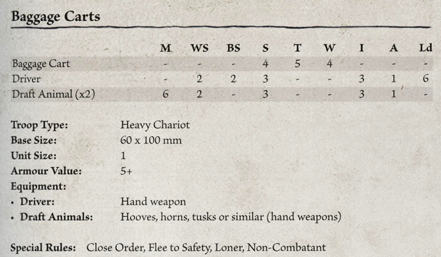
It cannot charge, pursue, overrun, Give Ground in combat, use Inspiring Presence, or use the Battle Standard Bearer’s Hold Your Ground rule.
It’s funny because here in Battle March they call them Carts instead of Trains—they use Train in regular Warhammer: The Old World—but when they explain how to represent them, they do say that the TRAIN occupies a 60×100 base. Nice little GW screw-up there.
Okay, whether you like these Secondary Objectives or not, here’s my advice: if your plan is to use Battle March to get into the game and eventually move on to larger, more competitive battles, don’t use either of them.
The reason is that you’ll end up getting tangled up in rules you won’t use later, and they’ll make your games slower.
On the other hand, if you want relaxed games, already know how to play, and can switch between larger and smaller battles without any trouble, simply looking for something different every now and then to enjoy the game, Secondary Objectives can add exactly that extra bit you’re looking for.
Random Events in Battle March
There are 3 types: Weather, Wilderness Terrain, and The Chaos of War.
You can use 0, 1, 2, or all 3 at the same time, depending on what you agree on with your opponent.
Disruptive Weather in Warhammer Battle March
Roll 1D6 before you start deploying and consult the table to see which effect will apply throughout the entire battle:
1: Heavy Downpour: All units suffer -1 to their Movement, to a minimum of 1, and Swiftstride cannot be used.
2: Fierce Gale: All shooting weapons with Strength 5 or lower reduce their range by 6″, to a minimum of 3″.
3: Scorching Heat: At the start of their turn, the active player rolls 1D6 for each of their units. On a roll of 1—or on a roll of 1 or 2 if they are wearing heavy armour, plate armour, or barding—roll 1D3 to determine how many models in that unit must pass a Toughness test or lose 1 Wound.
4: Lightning Strikes: At the start of their turn, the active player rolls 1D6. On a result of 1 or 2, one of their units, determined at random, suffers 1D6 Strength 4 hits with AP 1.
5: Dust Devil: Place the 3″ round template in the centre of the battlefield and scatter it 2D6″. At the start of each player’s turn, it scatters 1D6″ in a random direction. If the template moves through a unit, or a unit moves through the template, that unit suffers -1 Weapon Skill and -1 Ballistic Skill until the next Start of Turn phase. The template can never remain on top of a unit, so if it scatters onto one, move it the minimum distance required for it to be completely clear of the unit.
6: Freezing Winds: At the start of each turn, the active player rolls 1D6 for each unit in their army. On a 1, the unit must make a Leadership test before moving, shooting, casting spells, or declaring a charge. If it fails, it cannot perform that action. Compulsory moves such as Giving Ground or fleeing are unaffected.
Wilderness Terrain in Warhammer Battle March
Unlike the previous table, here you roll 1D6 the first time a unit deploys or finishes its movement inside a piece of natural terrain—woods, rocks, hills, and so on. This determines the properties that terrain feature will have for the rest of the battle.
1: Briar Patch: It counts as difficult terrain, but if you march, charge, flee, or pursue through it, it also counts as dangerous terrain.
2: Defensive Position: The unit occupying it counts as defending a low linear obstacle, and units charging it are considered Disrupted.
3: Toxic Spores: Every model that ends its movement completely within the terrain feature must make a Toughness test and, if it fails, loses 1 Wound.
4: Lingering Magic: Units within this terrain gain Magic Resistance (1).
5: Healing Herbs: Immediately when this result is generated, and at the start of every subsequent turn, a single model within this terrain feature that is not engaged in combat, fleeing, or affected by a failed Stupidity test recovers 1 Wound.
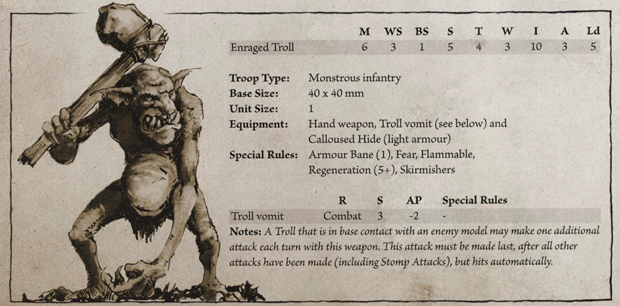
6: Troll’s Lair: Place an angry Troll in base contact with the front of the unit that discovered the terrain effect. If they are Skirmishers, put them into combat formation first. The Troll counts as having charged and immediately fights one round of combat against the unit. If the Troll loses, remove it from the battlefield and the winning unit reforms without having to take a Leadership test—there are no more Trolls in that terrain feature if you approach it again. If the Troll wins, it goes back into its cave until another unit encounters the terrain feature, at which point the process is repeated.
The Chaos of War in Warhammer Battle March
From turn 2 onwards, the player who takes the first turn rolls 1D6. If they roll a number equal to or lower than the current turn number, their opponent rolls 1D6 on the table. Any result that has already been generated must be re-rolled.
1: Aetheric Instability: Whenever a player makes a Casting roll, any double 1, 2, or 3 causes a Miscast, while any double 4, 5, or 6 causes Perfect Invocation.
2: Misplaced Resources: Roll a scatter die in the centre of the battlefield and follow the arrow towards the battlefield edge, as this will be the point through which a Baggage Cart enters. Its owner is whichever player rolls highest in an opposed 1D6 roll.
3: Dwindling Ammunition: Units with missile weapons can only fire them once every two turns.
4: Treasures of the Backcountry: Treasure Troves are worth 20 VP and the Landmark is worth 50 VP instead of the usual amount, which is half that.
5: Drawn-out Conflict: The battle lasts for 6 turns.
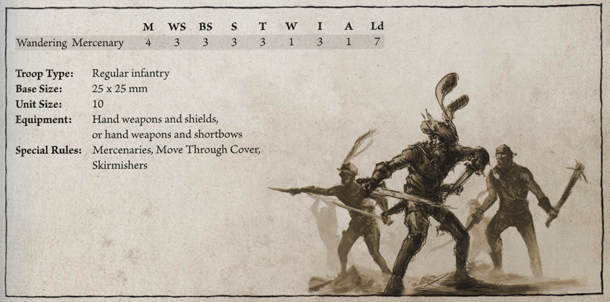
6: Wandering Mercenaries: The winner of an opposed roll gains a unit of wandering mercenaries. If the roll is tied, each player gets a mercenary unit. The mercenaries arrive immediately following the Reinforcements rules, from any battlefield edge. If they are killed, they are worth 50 VP.
I have to say that a lot of this stuff feels way too random to me, BUT I know that for plenty of players this is exactly what they’re looking for, and having a Troll pop out of a hill, smack your general over the head, and then go back to sleep in its cave could turn into one of those stories you remember for the rest of your life.
Also, keep reading until the end of the post, because some of the optional Magic Items combine with these tables.
Muster Lists in Battle March
This is designed for multi-game events:
Each player prepares 2 lists instead of one. Both must belong to the same faction, and one can be an Army of Infamy while the other is a Grand Army.
Before each battle, each player must show both lists to their opponent. Afterwards, each player secretly chooses which list they are going to use, and both choices are revealed simultaneously.
In any case, every player must use both lists at least once during the event.
I’ve already seen several events around my local area adding this to their event packs, and people seem pretty happy with it. At the end of the day, it helps prevent you from running into that typical list against which you literally have nothing you can do and only one player gets to have fun. On top of that, it lets you make one list a bit harder and the other a bit more fun and off-meta, because we shouldn’t forget that events have both more experienced players and newer ones. This lets you adapt to that if you want to.
Secret Objectives in Battle March Warhammer Old World
This is designed for multi-game events, just like the previous pack.
There is a list of objectives below, and each player must choose as many of them as there are games in the event. So, for the typical 3-game tournament, you choose 3 of the objectives.
At the start of each battle, the player must secretly write down which of their Secret Objectives they are going to use in that game. It is revealed at the end, when Victory Points are being counted.
The same Secret Objective cannot be chosen for more than one different battle.
GW also gives us a way to use these Secret Objectives in one-off games: randomly generate 3 for each player and choose which of those 3 you are going to play. If you cannot complete any of the 3 because neither your list nor your opponent’s list allows you to complete any of them, generate another 3.
These are the available Secret Objectives:
20 VP for causing an enemy unit to Fall Back in Good Order or flee during a Shooting phase.
20 VP for having, at the end of the battle, a Unit Strength 5+ unit within 3″ of a battlefield edge while also being inside the enemy deployment zone.
20 VP for killing a unit champion in a challenge. If you kill a character instead of a champion, you score 30 VP. This can only be completed once.
25 VP. At the start of the battle, secretly choose a terrain feature. At the end of the battle, you must have a Unit Strength 5+ unit completely within that terrain feature.
30 VP for having, at the end of the battle, Unit Strength 5+ units completely within 2 different terrain features that are either rocky terrain or woods.
40 VP for controlling a Strategic Location or building at the end of the battle.
50 VP. Secretly choose a friendly unit at the start of the battle. It must still have Unit Strength 5+ at the end of the battle and must not be fleeing.
50 VP for killing, or having fleeing at the end of the battle, an enemy Monster, Monstrous Infantry, or Monstrous Cavalry unit.
50 VP for successfully casting two spells, including Bound Spells, without them being dispelled during the same turn, or for dispelling 2 enemy spells without suffering a Miscast during the same turn.
75 VP if there are no enemy Unit Strength 5+ units inside your deployment zone at the end of the battle.
If you look closely, only one of the Secret Objectives has anything to do with magic. In Battle March, it’s quite common not to include Wizards in your army, so if you prefer playing that way, you still have the option of completing practically all of them.


Battle March Magic Items in Warhammer The Old World
Remember: these can only be used in Battle March lists, so don’t go using them in regular games—according to GW.
Now, my version: considering that this is OPTIONAL even within Battle March, and you have to agree with your opponent whether you’re going to use them or not, there’s nothing stopping you from agreeing to use them in a “non-Battle March” battle. I don’t think any of them would break the game in 2,000-point battles.
Let’s see what we’ve got. There are quite a few, with the cheapest costing 5 points and the most expensive 30.
Battle March Magic Weapons
Skirmisher’s Blade: 25pts. +1 Attack and AP 1. Re-rolls rolls To Wound when attacking an enemy in the flank or rear.
Thornspitter Stave: 20pts. In combat it grants +1 Strength, with no AP and only Armor Bane (1), and it can also be fired at 24″ with Strength 4, Armor Bane (1), and Ponderous.
Trailblazer’s Hatchet: 15pts. Can only be equipped by Infantry models. +1 Strength, AP 1, Flaming Attacks, and it also has an additional effect: ONCE PER BATTLE, during your Start of Turn phase, you can use it to give its unit the Move Through Cover special rule.
Diestro’s Blade: 10pts. AP 1 and +1 Initiative.
Of the 4 weapons, I think the 15-point one is the only one that might actually be useful. The others are all worse than a simple mundane great weapon. Skirmisher’s Blade is far too situational, I think Thornspitter Stave has a shooting attack that is too weak and that you probably won’t use most of the time, and as for the 10-point one… well, let’s just say Initiative isn’t exactly the most important characteristic in a game where you gain Initiative bonuses when you charge.
Trailblazer’s Hatchet can be useful for making a surprise charge through a terrain feature separating you from the enemy, when your opponent feels safe behind it because they don’t expect you to risk declaring a charge knowing you suffer -1 Movement and have to choose the lowest die instead of the highest from your Charge roll. Although there are armies with banners that let you Move Through Cover every turn, such as Orcs & Goblins.
Battle March Magic Armour
Helm of Courage: 25pts. +1 Armour Value. Once per battle, it allows you to re-roll the 2D6 when making a Break test. It can be worn alongside other armour.
Padded Hauberk: 20pts. Heavy armour that improves its Armour Value by an additional 1 against attacks with no AP.
Iron-rimmed Shield: 15pts. A shield that gives its bearer—not their mount—+1 Attack made with a mundane hand weapon.
Shadowed Mantle: 10pts. Infantry only. Light armour that prevents the enemy from choosing this model as the target of shooting attacks or spells if it is within 6″ of a friendly unit, even if the bearer is the closest target.
Again, I think only 1 of these armour items can really be useful, in this case Shadowed Mantle, although it isn’t exactly incredible either because it’s limited to Infantry. I do think it’s an interesting item.
The other 3 provide a benefit that is simply too small and gets overshadowed by the Ward Save provided by either of the two common magic shields in the rulebook that everyone has access to and, in some cases, by army-specific items.
Battle March Talismans
Talisman of Authority: 30pts. One use only. When activated, models that want to attack the bearer in combat must make a Leadership test and, if they fail it, cannot attack this turn.
The Warding Talisman: 15pts. 6+ Ward Save.
I don’t like either of them. Overpriced. Nothing else to add.
Battle March Magic Standards
Banner of Renown: 15pts. One use only. +1 Combat Result.
The Banner of the Bold: 10pts. The unit gains the Veteran special rule—the unit can re-roll all Leadership tests, but not Break tests.
The first banner is overshadowed by the classic 25-point War Banner, which can be used in every round of combat for only 10 points more and which we already don’t see that often because there are better options.
The 10-point banner can be very interesting for Terror tests and other situations, but bear in mind that this is Battle March, a low-points battle where large Monsters and Dragons aren’t that common.
Battle March Enchanted Items
The Ranger’s Glass: 20pts. ONLY IF YOUR GENERAL carries it, you gain +1 to the roll to determine who gets the first turn. If both generals have one, make an opposed roll to determine who gets the +1.
The All-seeing Eye of Numas: 15pts. The bearer—not their unit—ignores penalties for partial or full cover and also ignores woods when determining line of sight.
Wilderness Map: 10pts. Common. Only useful if you’re using the Wilderness Terrain rules pack. It allows the bearer’s unit to re-roll the D6 when rolling on the terrain table.
Enchanted Almanack: 5pts. Only useful if you’re using the Chaos of War rules pack. It allows you to re-roll the D6 when rolling on the table.
I think the last two are very useful if you’re going to use the relevant rules packs, because they’re really cheap. I think the other two are overpriced—I don’t think getting the first turn is THAT important in Battle March.
Battle March Arcane Items
Scroll of Fiery Convocation: 15pts. Common. One use only. Instead of attempting to cast a spell they know, the bearer can cast Fireball.
Scroll of Deathly Whispers: 10pts. Common. One use only. Instead of attempting to cast a spell they know, the bearer can cast Deathly Cabal from Necromancy—the one that gives the caster’s unit a 6+ Ward Save and Fear.
Wyrdstone Shard: 10pts. One use only. Before casting a spell or attempting to dispel one, the bearer can use it to apply +1 to the roll.
Scroll of Obfuscation: 5pts. Common. One use only. Instead of attempting to cast a spell they know, the bearer can cast Confounding Convocation from Illusion—the Stupidity one.
The Fireball scroll might seem a little expensive, but remember that this is Battle March: there are fewer units, and a lot of them are going to be made of tissue paper, so a Fireball can do a lot of damage. 15 points for the chance to make an entire unit disappear in a game mode where the Ruby Ring is expensive… it could work.
In any case, overall the Magic Items we already had between the main rulebook, the Arcane Journals that have kept adding more, and each army’s own items… are better than these.
The one I would include is the item that lets you re-roll on the Random Events table if you’re going to use it. Being able to avoid the angry Troll attack for so few points is priceless.
That’s it. I’m leaving the general Battle March post below as well, where I also put together a breakdown of which miniature boxes I would buy to get started with each army while spending as little money as possible—so instead of 1 army, you can buy 2.
Hope you find it useful.
Chaos Dwarf Old World List: WTC 2026 World Championship Winner
Hordes of Chaos | New Army of Infamy | The March of Chaos Arcane Journal
NEW COMMON MAGIC ITEMS | Arcane Journal The March of Chaos
Any errors in the post? feel free to reach out at theoldwarrior@theoldwarrior.com.