
Magic in The Old World has been updated. Well, it will be soon in the Arcane Journal in August 2026.
In any case, I’ve already gone through the book and I’m bringing you all the content here, properly broken down and laid out, as always whenever something new comes out.
The content of the Arcane Journal called The March of Chaos is divided into three parts:
First, we have the updates to magic, which is what this post is about.
The idea behind this post is for it to work as a quick reference, so you don’t waste time looking things up in the middle of a game.
Then, a new Army of Infamy (Hordes of Chaos) have been released, AND we got some more common magic items for every army to purchase. I’ll analyze these in separate posts (I’ll leave them at the end of this one so you can check them out when you’re done).
Let’s get to it.
I’m not going to analyze this in the order GW wrote it in the book, but in the order I think makes it easier to understand: the new miscast table, Channelling, Arcane Magic Ploys and finally Sorcerous Ruses.
New Miscast Table for Warhammer The Old World (The March of Chaos, Disastrous Miscasts)
Well, they’ve called it Disastrous Miscasts, so you can already tell that the effects are harsher than those on the table we’ve had in the rulebook until now.
This section tells us that if you’re going to use either of the following two magic rules packs (Channelling or Arcane Magic), YOU MUST ALSO USE this miscast table I’m about to describe instead of the one in the rulebook.
However, they add an extra note: they recommend using this table EVEN IF neither of the previous rules packs is being used, especially in competitive events.
Here it is. Let’s see what you think about it (it’s pretty straightforward; generally, each result reduces the Strength of the hits by 2 and their AP by 1 as you go down the table):
2-3: Roll a scatter die. If you roll an arrow, place the narrow end of the flame template over the center of the wizard’s base and point the wide end in the direction shown by the scatter die. If you roll HIT, instead of using the flame template, center the 5-inch round template over the wizard. The wizard dies and every model under the template (work out how many partial hits there are) suffers a Strength 10 AP -4 hit.
4-5: Center the 5-inch template over the wizard and every model under it (work out the partials) suffers a Strength 8 AP -3 hit. In addition, the wizard can no longer cast any more spells this turn.
6-7: Center the 3-inch template over the wizard and every model under it (work out the partials) suffers a Strength 6 AP -2 hit.
8-9: The wizard suffers a Strength 4 AP -1 hit and, until the end of the battle, suffers a -1 modifier to his casting rolls. If this happens again, these negative casting modifiers ARE cumulative with no limit.
10-11: The wizard and his unit Give Ground directly away from the nearest enemy (if for any reason they cannot do so, the wizard suffers a Strength 6 AP -2 hit). In addition, until the end of the battle, the wizard suffers a -1 modifier to his casting rolls. If this happens again, these negative casting modifiers ARE cumulative with no limit.
12: The spell is cast with Perfect Invocation and the wizard reduces his Wizard Level by 1 and forgets the spell he just cast. In addition, the wizard cannot cast any more spells this turn.
If we take into account that magic is still pretty powerful in the game, I see this as a nerf, toning down something that is already strong in an attempt to balance it out. And I think that’s good.
BUUUT I think they’ve gone about it the wrong way. I think they should focus more on balancing not just the Lores, but also the spells within the same Lore. So you don’t have some spells that break the game while others are absolutely useless.
That’s more or less the serious part of the Arcane Journal done. Now the party, the fun and the madness begin:
Magic in The March of Chaos Arcane Journal: Choose Your Own Adventure
Do you remember those books where they asked what you wanted to choose and then sent you to one page or another depending on your decision? Well, magic is basically the same now.
They give us 3 rules packs and tell us that you can use all of them, none of them, or whatever combination you prefer (two yes, one no, just one of the three…).
But GW itself recommends not including all 3 at the same time in competitive events (you’re about to see how ridiculous this gets, brace yourselves).
The names are: Channelling The Winds of Magic, Arcane Magic Ploys and Sorcerous Ruses.
Let’s go through them one by one.
Channelling The Winds of Magic
This basically gives you a pool of magic dice to do things with, and each player has to manage them throughout the game because they don’t replenish in any way.
To play with this rules pack, a new sequence is introduced before the game begins:
1 Generate dice for a wizard. Depending on his level, he generates a different number of dice:
Level 1: 1D3 dice
Level 2: 1D3 +1 dice
Level 3: 2D3 dice
Level 4: 2D3+1 dice.
Write down how many dice each wizard generated, because you’ll need to keep track of them throughout the entire game.
Optional step 1.5 to keep in mind: If, in addition to Channelling The Winds of Magic, you’re also going to play with Sorcerous Ruses (the final rules pack I’m going to describe), this is when you would roll on the Ruses abilities table.
2 IMMEDIATELY AFTERWARDS, GENERATE THAT WIZARD’S SPELLS (in the normal way: roll as many dice as your Wizard Level in a Lore… the usual).
3 Repeat steps 1 and 2 separately for each of your wizards (in whatever order you want; higher-level wizards don’t have to roll first, you choose).
How do you spend Channelling The Winds of Magic dice in Old World?
Each wizard can only spend his own dice. They are not shared between all your wizards.
There is no limit to how many dice a wizard can spend each turn. If you want, you can burn through all of them in the same turn.
What can Channelling The Winds of Magic dice be used for in Warhammer?
They can be used for 4 different things:
Generating spells: Remember how before you could only swap one of the spells you generated for the signature spell? (unless you had a familiar Lore, of course…)
Well, now you can spend one of your previously generated dice to reroll one of the spells you generated that you don’t like (but you have to keep the result of the reroll; you can’t reroll it again or choose the spell you originally rolled if, for example, you somehow get an EVEN WORSE spell on the reroll).
Casting and dispelling spells: You can choose to add one extra die to your casting or dispel roll and discard the lowest result (so instead of casting or dispelling with 2D6, you roll 3D6 and discard the lowest of the three). If you roll two 1s among those three dice, it counts as a miscast.
Rerolling the roll afterwards: If you fail a casting or dispel roll, you can spend TWO DICE to reroll the entire roll (unless it was a miscast).
Increasing casting or dispel range: Before attempting to cast or dispel a spell, you can spend one of these dice to increase the range. If you decide to do so, roll a die. The result is the number of inches by which the range increases.
I think it’s playable. I think it’s fun. But maybe what this actually does is make an already powerful part of the game even stronger, and warped minds like mine will start coming up with completely broken, absurd combinations to destroy the universe if this starts being played competitively.
If it doesn’t make it into competitive play, no problem. People will use it and have fun with it whenever they want, either on its own or combined with the Ploys I’m about to explain.
Arcane Magic Ploys in Warhammer The Old World
This is the second magic rules pack Games Workshop gives us, which can be played on its own or alongside the other two. It’s a set of advantages randomly generated at the start of the game for each player, and each one can only be used once per game.
There are 11 different ones. Each player generates 6 at the start of the game, regardless of how many wizards they have or their Wizard Levels. You get them even if you don’t have any wizards at all.
There are 3 generation methods:
1 Draw cards, each player from their own deck (they now sell some ridiculously expensive card decks with 56 cards in total. I can’t find them right now, not even on preorder, otherwise I’d put them here so you could see them… maybe I jumped the gun a little by already publishing this post).
2 Draw cards, with both players drawing from the same deck.
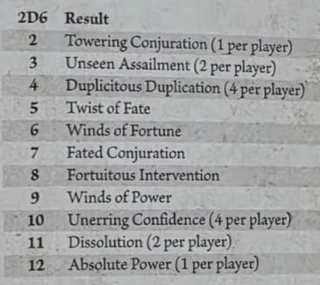
3 Roll 2D6 on the table below.


Limitations of Magic Ploys in Warhammer
If you generate the same Ploy more times than allowed, reroll to generate a different one.
These Ploys can only be used once during the game, and each player can only use one per phase.
(Below, I’m going to describe each Ploy, starting with number 2 and skipping number 1, since when rolling 2D6 the minimum result you can get is 2):
What does each Arcane Magic Ploy do in The Old World?
2 Towering Conjuration: When casting a spell, this allows the caster to do so while ignoring line of sight and range restrictions (your Necromancer had better not wander too far from his troops, otherwise he’s going to get a fireball dropped on his head from the sky).
3 Unseen Assailment: Allows any of your wizards to attempt to dispel even if they are in combat or out of range. The only case where it cannot be used is if the wizard failed a Stupidity test this turn.
4 Duplicitous Duplication: Used immediately after successfully casting a spell or Bound Spell (whether the enemy dispelled it or not). It allows you to cast the same spell again, either at the same target or a different one. Keep in mind that this second casting does not count towards the limit of spells the wizard can attempt to cast in the same turn (so a Level 4 Wizard can cast 4 different spells, using one of them twice thanks to this Ploy).
5 Twist of Fate: Allows you to reroll on the miscast table, but you have to accept the second result.
6 Winds of Fortune: Allows you to attempt to dispel a spell with 3D6, discarding the lowest die instead of using 2D6. It can be used both for a wizard’s dispel attempt and for Fated Dispel, but if you roll two 1s among those three dice, it causes a miscast.
7 Fated Conjuration: You can reroll the casting roll of a spell or Bound Spell when you fail it.
8 Fortuitous Intervention: You can reroll a failed dispel attempt against an enemy spell, either by a wizard or through Fated Dispel.
9 Winds of Power: Allows you to attempt to dispel a spell with 3D6, discarding the lowest die instead of using 2D6. It can be used both for a wizard’s dispel attempt and for Fated Dispel. The difference compared with number 6 is that you won’t suffer a miscast unless you roll three 1s.
10 Unerring Confidence: You can use this when you suffer a miscast, before rolling on the table. It lets you roll twice on the table and choose which result to keep.
11 Dissolution: Automatically dispels a spell, either through Fated Dispel or a wizard’s dispel attempt.
12 Absolute Power: When you roll any double except double 1 while casting a spell or Bound Spell AND AT THE SAME TIME EXCEED the spell’s casting value (matching it isn’t enough, the book says EXCEED), this lets you cast it with Perfect Invocation.
Maybe all of this already sounds extremely random to you, especially considering that there isn’t even one fixed generation method. It’s basically a complete free-for-all, because you don’t have the same odds of getting one result or another if both players draw from the same deck, if each draws from their own deck, or if you roll on a table using 2 dice… anyway.
I’d bet an arm that these Ploys are not going to be played competitively. Maybe in one of those doubles tournaments with an open bar, although I don’t think so either because the drunk guys are 100% going to leave the card deck at home.
Apart from that, I think this is like when they released Hidden Objectives a while ago, those missions that gave you extra points for killing the General, casting X number of spells in one turn…. I think they make the game more complicated and slower.
Right now I’d say that, out of Sigmar, 40k and Old World, this is the most complicated of the three to play and WE DON’T WANT to make it even more complicated.
Anyway, if this already seemed like a complete circus to you, I’ve saved the craziest rules pack of them all for last:
Sorcerous Ruses in Warhammer The Old World
These are random abilities that any wizard from any army can buy for 25 points.
Every wizard can buy one, regardless of level.
That said, only 1 per wizard. They can be used only once per battle (Thanks Tomas!)
The ability is generated immediately before generating that wizard’s spells, by rolling 1D6 on this table (several wizards in the same army can generate the same ability).
1 Escapology: The first time the wizard dies, on a 4+ he comes back to life in the same place with 1 Wound.
2 Daemonic Assailants: This can be used instead of attempting to dispel an enemy spell. Both wizards roll a die, and the caster adds HIS TOUGHNESS to that roll, while the wizard attempting to dispel adds his WIZARD LEVEL.
If the caster’s total is higher, the spell is cast normally.
If it’s a tie, the spell is dispelled.
If the dispelling wizard’s total is higher, the spell is dispelled and the enemy also suffers 1 Wound with no armour save or Regeneration allowed.
3 Spell Thief: This can be used instead of attempting to dispel an enemy spell. Both wizards roll a die and add 1 if they are Level 1 or 2, or add 2 if they are Level 3 or 4.
If the caster’s total is higher, the spell is cast normally.
If it’s a tie, the spell is dispelled.
If the dispelling wizard’s total is higher, the spell is dispelled and that enemy wizard cannot attempt to cast that spell again for the rest of the game.
4 Duplicitous Mirror: This can be used instead of attempting to dispel an enemy spell. Both wizards roll a die and add their Wizard Level.
If the caster’s total is higher, the spell is cast normally.
If it’s a tie, the spell is dispelled.
If the dispelling wizard’s total is higher, the target of the spell becomes the caster’s own unit (so this ability doesn’t work against enemy buffs).
5 Magical Syphon: This can be used instead of attempting to dispel an enemy spell. The casting wizard rolls 1D6 and adds his Leadership, while the dispelling wizard rolls 2D6 and adds his Wizard Level.
If the caster’s total is higher, the spell is cast normally.
If it’s a tie, the spell is dispelled.
If the dispelling wizard’s total is higher, the spell is dispelled along with every other enemy spell currently active at that moment (not just Remains in Play spells).
6 Spell Eater: This can be used instead of attempting to dispel an enemy spell, and the spell is automatically dispelled unless it was cast with Perfect Invocation. If it was, roll the dice; if you roll double 6, it is dispelled.
The wizard who used this ability can roll 3D6 for his next casting roll, discarding the lowest result instead of using the usual 2D6. In this case, it only causes a miscast if he rolls three 1s.
This last one is just… completely ridiculous.
So you’re telling me this lets me automatically dispel EVERY SINGLE SPELL unless it’s cast with Perfect Invocation?
I know randomness has always been, to some extent, the essence of magic in Warhammer, but maybe THIS isn’t the kind of randomness we want.
I don’t know.
Anyway, I just hope this post helps you quickly check everything while you’re playing with any of these rules. Send it to your mate if you want to support me, and if you want to give me your money, it’s down here.
Hordes of Chaos | New Army of Infamy | The March of Chaos Arcane Journal
NEW COMMON MAGIC ITEMS | Arcane Journal The March of Chaos
Warhammer Battle March: All the New OPTIONAL Content
Any errors in the post? feel free to reach out at theoldwarrior@theoldwarrior.com.